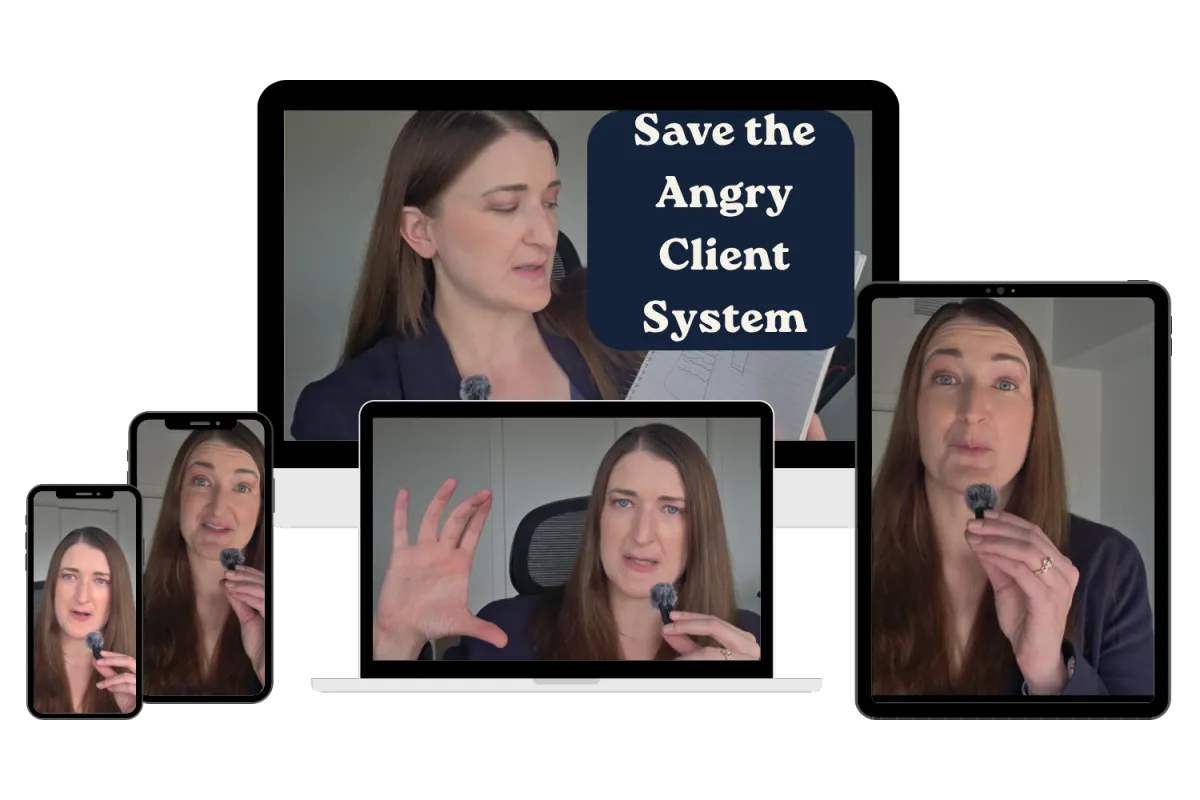
For the account you can’t afford to lose

Save the Angry Client Before They Leave

See how you can save your next 4, 5, 6, or 7-figure client in less than 90 minutes.

The exact 4-step system I use to calm angry clients, rebuild trust, and walk into the hard conversation knowing precisely what to say — even if you don’t have authority, a discount budget, or weeks to fix it.

Built in real client fires, not a marketing workshop

I built this in the meetings nobody else wanted to take.

15+
Years in the hard meetings

I’ve been the person companies put in the room when the client was angry, disappointed, and already reaching for the exit — not because I had a discount to hand out or a title that scared anyone, but because I knew how to read the situation and run the conversation. That’s the system this hands you.

A trust breakdown

From “we don’t believe you” to public advocate

Before The client had stopped trusting anything we told them.

After Weekly recovery meetings, clear ownership, nowhere to hide — the relationship stabilized, and they later spoke up for us publicly.

A VP exposed internally

From frustrated VP to buying more

Before A VP was frustrated and on the hook in front of her own leadership.

After I rebuilt trust in person, the account turned around — and she didn’t just stay, she expanded.

An account in threat mode

From breach language to future planning

Before Legal, procurement, and contract-breach language were sitting in the background.

After The right people, the right rhythm, and the right escalation moved the client back into talking about what comes next.

These examples are from my own experience and aren’t a guarantee of your outcome. What the system gives you is the structure I use to handle the conversation — so you’re not improvising when the account is on the line.


What walking in unprepared actually costs

Most people improvise the worst client call of the year. Then they pay for it.

When you don’t have a plan for the angry-client conversation, you reach for the only moves panic offers — and every one of them makes the next renewal harder:

× You discount, and quietly teach the client that pressure works.
× You over-promise to stop the bleeding, then miss it and reopen the wound.
× You apologize so hard you start to sound unsure of your own work.
× You escalate to leadership too early and lose control of the account.
× You go silent because you don’t know what to say — and silence reads as guilt.
× You lose the client, the income, and the reference you’d have earned by saving them.
You don’t need the things you think you need

You don’t need power. You need a plan.

Most people panic because they assume saving an angry client takes authority, money, executive backup, or some flawless apology. It doesn’t.

× A discount budget

Discounting usually teaches the client that pressure pays. This shows you what to say before money becomes the only thing left on the table.

× Your CEO swooping in

You don’t need to drag leadership into every fire. You need to know when to escalate, who to involve, and what to prepare first.

× The perfect apology

A bad apology makes things worse. You’ll learn to acknowledge the problem without sounding weak, desperate, or creating new risk.

× Weeks to fix it

This is built for the call that’s already on your calendar — when the client is upset and you need to show up prepared now.

What you actually need is simpler.

You need to know who matters, what to say, what not to promise, when to escalate, and how to turn the conversation into a recovery plan the client can believe. That’s the whole system.

The complete system, lesson by lesson

Everything you get to walk into the angry-client call prepared.

This isn’t a theory course. It’s the practical system I wish every account manager, CSM, consultant, freelancer, and agency owner had before the client says, “We need to talk.” Sixteen short video lessons, organized into the four phases I move through every time — so you walk into the next conversation knowing exactly what to do.

Phase One

Diagnose — get the full picture before you say a word

  • Read the real temperature. Tell whether the client is angry, disappointed, or being squeezed by their own boss — because each one needs a completely different response, and guessing wrong is how a saveable account becomes a lost one.
  • Find the real problem, not the loudest one. How to pull the full story from your notes, your CRM, and the people inside your own company before you respond — so you fix what’s actually broken, not the surface complaint.
  • Never depend on one relationship. Why a single contact is how good accounts get lost overnight, and how to build trust with the right people across the client’s org — who’s angry, who holds the power, and who can quietly block the renewal.
  • Know your exposure early. How to spot when contract terms, procurement, or legal could come into play, so a breach email never blindsides you.
Phase Two

Rescue moves — what to say and not say when it’s tense

  • Run the call with questions, not answers. The open-ended questions that get the real story — and why you stop talking, refuse to solve it live, and come back with a firm date instead of over-promising.
  • The apology that actually works. Why opening with “I’m sorry” makes them angrier, and the order that lands instead — reflect back what you heard, lay out the plan, then apologize at the end.
  • Keep money off the table. Why most clients don’t actually want a discount or credit, what they want instead, and what it means the moment a client does demand money back.
  • Deliver bad news without setting off another explosion. Why you do it by phone and never by email, and the simple way to say “here’s what happened, here’s how we’re fixing it.”
  • Escalate by authority, not panic. When to bring in leadership, legal, or a senior heavy-hitter who can actually make commitments — and how to prep them so nobody over-promises or contradicts you in front of the client.
Phase Three

Track progress — show the client it’s actually moving

  • Make progress impossible to miss. The meeting cadence that rebuilds trust — and exactly when to dial it back from weekly to monthly as things stabilize.
  • Run check-ins that demonstrate value. The questions that surface concerns before they blow up — “how do you think it’s going? what do you wish we were doing?” — and show the client you’re actually listening.
  • Prove it with facts, not feelings. How to show measurable improvement over time, so the client believes the relationship is genuinely turning around — not just temporarily quiet.
Phase Four

Stabilize — turn the save into a stronger relationship

  • Know when it’s actually safe. The signals that tell you trust is back — and how to read timing and body language before you make any ask.
  • Turn a save into a referral. How to ask the right way and stay silent after — and why knowing what personally drives your client makes the ask easy.
  • Turn a save into an expansion. How the “do you want to add this?” conversation becomes natural once the problem’s actually fixed.
  • Get ahead of renewal risk. Why you raise renewals early instead of at the deadline, how to build the case around the client’s own use case, and the “leaky bucket” way to think about every account you keep.
Who is this for?

Whoever answers the angry email, this was built for you.

Whether you own the business, manage the account, deliver the work, or run the project — if the client expects you to help fix it, you’re in the right place.

Account Manager
Customer Success Manager
Client Success Manager
Account Executive
Sales Rep
Business Development Rep
Client Services Manager
Implementation Manager
Onboarding Specialist
Project Manager
Service Delivery Manager
Agency Owner
Consultant
Freelancer
Service Provider
Coach / Strategist
Designer / Developer
Marketing Consultant
Social Media Manager
Ads Manager
SEO / Email Specialist
Virtual Assistant
Online Business Manager
Operations Consultant
Get the full system today
$27

16 short video lessons that take you through all four phases — how to diagnose the risk, calm the conversation, get the right people involved, and stabilize the account — so you stop improvising when it’s on the line.

Instant access. The moment you check out, the full system is yours — watch on your laptop or your phone and start prepping your next call within minutes.

Before you decide

The questions you’re probably asking.

My client already has one foot out the door — is it too late for this to help?
Maybe — and I won’t pretend every account can be saved. But this is built for exactly that moment. Even when a client is already talking about leaving, the system tells you what to say, who to involve, and how to give the relationship its best possible shot. The worst position is walking into that conversation without a plan, and that’s the one thing this gives you.
Will this work for my kind of client? I’m not in big enterprise sales.
Yes. Whether your client is a Fortune 500 account or a single retainer that covers your rent, an angry client is an angry client: trust broke, someone’s under pressure, and they need to believe things will actually change. The system works on the relationship, not the size of the logo.
Do I have to watch all 16 lessons before my call?
No. If you’ve got a hard conversation on the calendar, jump straight to the fastest rescue path — what not to promise, how to show proof, how to save trust in the conversation, and how to spot the renewal leak. You can get the emergency path in about 15 minutes and come back to the rest later.
How do I get access, and how soon?
Instantly. The moment you check out, all 16 short video lessons are yours — watch on your laptop or your phone, and you can start prepping your next client conversation within minutes.
Isn’t this just communication advice I could find for free?
No. Free advice usually says “stay calm, listen, and apologize.” That’s not enough when revenue is on the line. This gives you the order of the conversation, what not to say, how to avoid bad promises, how to show visible progress, and how to keep the client from quietly building the case to leave.
Only $27 — what’s the catch?
No catch. I priced it low because when a client relationship is on the line, the cost of the system should not be the reason you walk in unprepared. One saved client can be worth thousands, tens of thousands, or more.

The hard conversation is coming whether you’re ready or not.

The relationship you’re about to walk into is worth thousands — sometimes millions — in revenue, renewals, and reputation. You can walk in hoping you find the right words in the moment, or you can walk in with the exact system I use to calm the client, rebuild the trust, and keep the account. One of those costs you only $27.

Privacy Policy Refund Policy Shipping Policy

This site is not a part of the Facebook website or Facebook Inc. Additionally, This site is NOT endorsed by Facebook in any way.
FACEBOOK is a trademark of FACEBOOK, Inc.